

This post contains affiliate links.
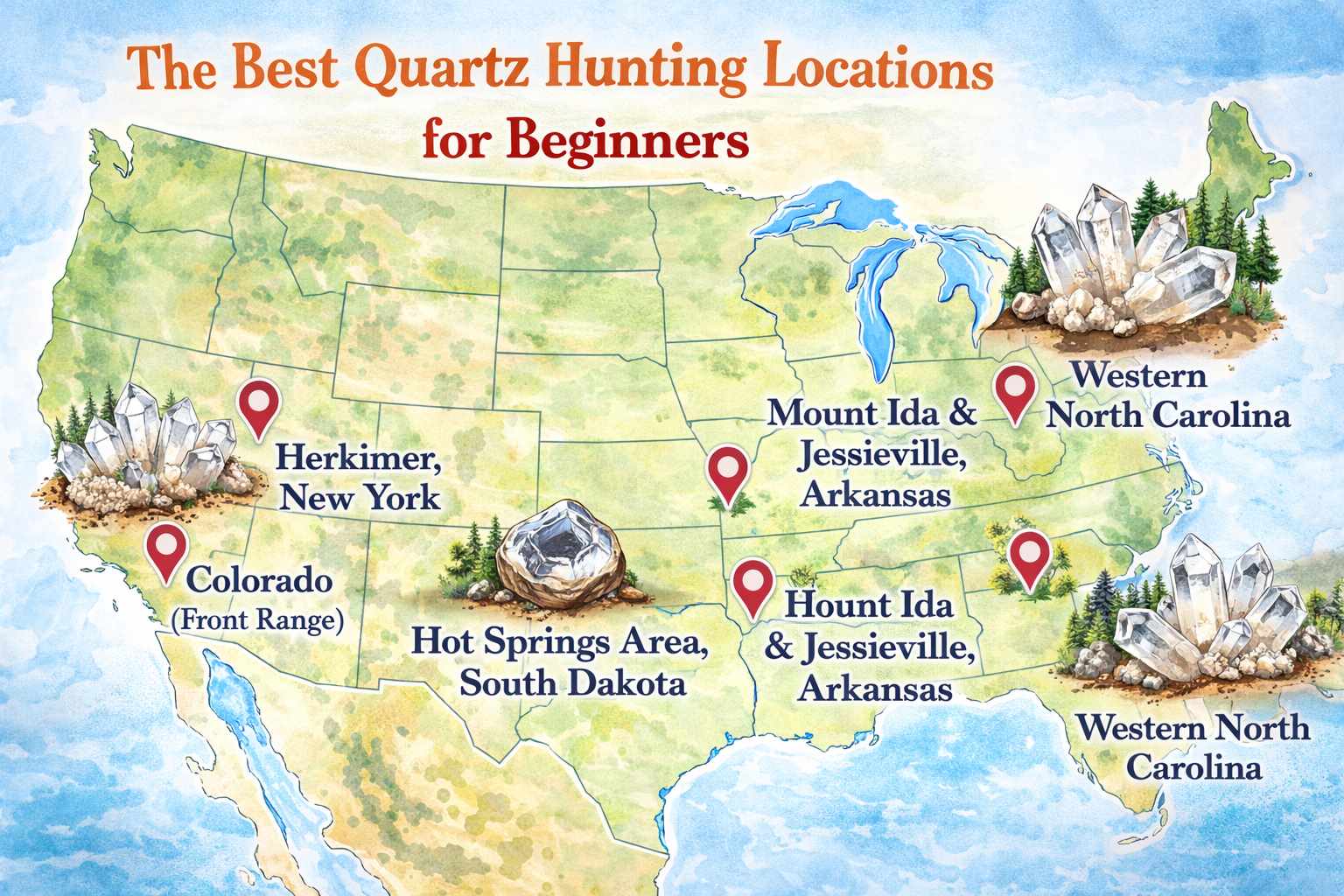
1) Mount Ida & Jessieville, Arkansas — “Quartz Crystal Capital of the World”
If you only take one quartz trip in the U.S., central Arkansas is the classic. The Ouachita Mountains are famous for clear quartz points, clusters, and big crystal pockets. The best part for beginners: there are many pay-to-dig operations designed exactly for first-timers.
What you can find
- Clear quartz points
- Clusters and plates
- “Window” quartz, phantoms, smoky varieties (occasionally)
- Very collectible crystals with good faces
Where to go (how to do it)
- Base yourself in Mount Ida (or nearby Jessieville/Hot Springs for more lodging options).
- Choose a pay-to-dig mine (search “Mount Ida quartz dig” and pick one that matches your style: some are “pocket digging,” others are “tailings digging,” which is easier).
- Call or check the mine’s website for:
- Hours, digging fees, bucket limits
- Whether tools are provided
- Whether they allow children
- Show up early (cooler temps, better energy, and you beat crowds).
- Ask staff: “Where are beginners finding points today?” They’ll usually direct you to productive piles.
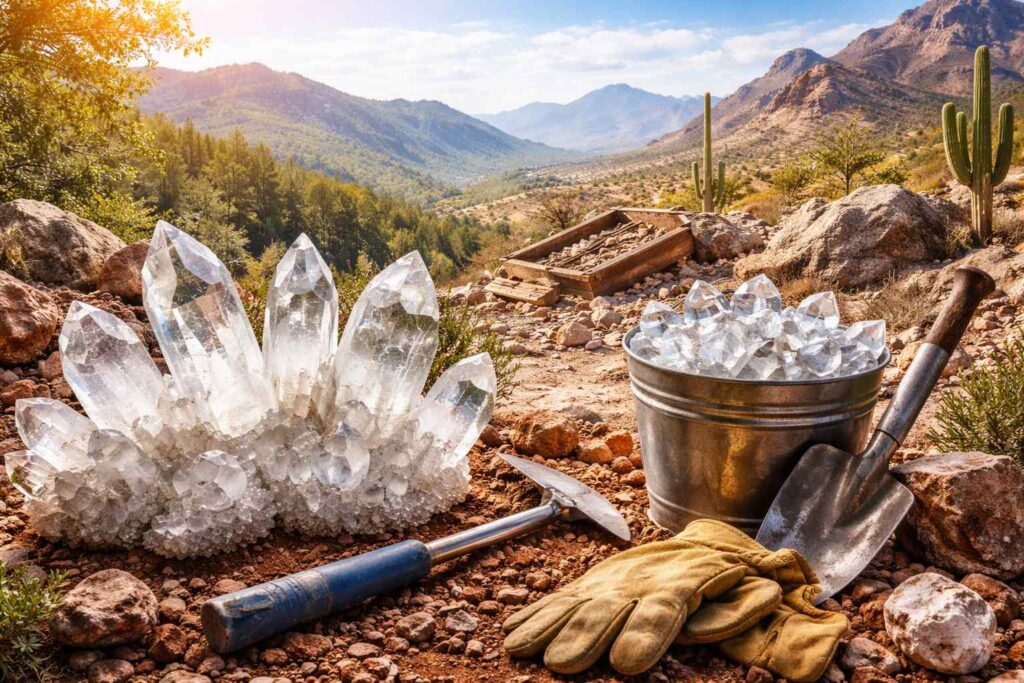
Beginner technique that works here
- In tailings piles: lightly rake, then look for glassy flashes in sunlight.
- In dirt/clay pockets: dig slowly; crystals can be fragile at the tips.
- Keep a spray bottle handy—the moment you rinse a piece, you’ll know if it’s a keeper.
Best season: Fall through spring (summer can be brutally hot). After rains can be great, but mud can slow you down.
2) Herkimer County, New York — Herkimer “Diamonds” (Double-Terminated Quartz)
Herkimer diamonds aren’t diamonds—they’re highly clear, naturally double-terminated quartz crystals found in dolostone. They’re famous because they’re bright, gemmy, and often come out looking like something you’d buy in a shop.
What you can find
- Clear double-terminated crystals
- Clusters (“plates”) and pockets
- Occasional inclusions (carbon, water inclusions)
Where to go (how to do it)
Most collecting is on private claims and pay-to-dig mines around the towns of Herkimer, Middleville, and nearby.
- Pick a commercial mine/claim that allows collecting for a daily fee.
- Bring:
- Eye protection (non-negotiable here)
- A crack hammer and cold chisel (or rent tools if offered)
- Work the exposed rock and rubble. The crystals often sit in cavities.
- Take your time splitting rock along natural fractures—don’t just smash wildly.
Beginner tip
Herkimers hide in gray rock. Watch for:
- Small vugs (cavities)
- Tiny sparkles on broken faces
Once you find a few small ones, you’ll “tune your eyes” and your success rate jumps.
Best season: Late spring through fall (winter is rough for outdoor digging).
3) Hot Springs Area, South Dakota — Fairburn Agate & Quartz Geodes (Nearby Regions)
South Dakota is famous for agates, but beginners can also find quartz-lined geodes and quartz druse in parts of the region (often as secondary finds while agate hunting).
What you can find
- Quartz crystals lining geodes
- Druzy quartz coatings
- Mixed material (chalcedony + quartz)
Where to go (how to do it)
- Use rockhound maps/guides for the Black Hills region and surrounding collecting areas.
- Stick to public collecting sites or fee sites where rules are posted.
- Search in gravels, washes, and eroded slopes where rounded nodules concentrate.
Beginner tip
Bring a small spray bottle. A dusty geode can look boring until you rinse it and see sparkle.
4) Southern California Desert — Clear Quartz, Smoky Quartz, and Desert Finds (With Land-Use Awareness)
The deserts of Southern California and the Southwest can produce quartz in veins and washes—sometimes clear, sometimes smoky, sometimes iron-stained “golden” quartz. This can be a great beginner option if you’re careful about land status (BLM vs. private claims vs. protected areas).
What you can find
- Quartz chunks and points
- Iron-stained quartz, occasional smoky quartz
- Smaller crystals in washes
Where to go (how to do it)
- Identify a specific legal collecting area (BLM land that allows casual collection, or a fee site).
- Check the area’s rules (some areas have active mining claims—don’t collect on claims without permission).
- Hunt dry washes and the base of hills after erosion events—look for quartz pieces that stand out against darker rock.
Beginner tip
In deserts, success is often about walking patterns:
- Grid a wash slowly
- Scan for “white flash” or glassy edges
- Don’t ignore ugly iron-stained pieces—some clean up beautifully.
Safety: Heat is real. Start at sunrise, stop mid-day, bring more water than you think.
5) Western North Carolina — Quartz, Smoky Quartz, and Mountain Stream Finds (With Permission)
North Carolina has a long gem and mineral history. You’ll see quartz in multiple forms, and there are also fee digs and educational gem mines that are beginner-friendly.
What you can find
- Milky and clear quartz
- Smoky quartz in some areas
- Quartz associated with other minerals (mica, feldspar)
Where to go (how to do it)
- Look for public “gem mine” style operations (many are family-friendly and provide buckets).
- Some mines focus on “salted” buckets (material brought in), but others have real local material and digging areas—read descriptions carefully.
- If you’re stream-walking: do it only where allowed and be respectful—many stream beds cross private property.
Beginner tip
If you want the “real digging” experience, prioritize operations that say:
- “Dig your own”
- “On-site material”
- “Native dirt”
Those tend to feel more like true rockhounding than sluice-only setups.
6) Colorado & the Front Range — Quartz in Veins and Pegmatites (Advanced-Adjacent, But Possible)
Colorado has quartz everywhere, but easy “walk up and find perfect points” spots are less common than Arkansas or Herkimer. Still, beginners can find attractive pieces in veins and float (loose chunks) in many mountainous areas—again, with land rules in mind.
What you can find
- Milky quartz veins
- Occasional clear points in pockets
- Smoky quartz in some districts
Where to go (how to do it)
- Choose known rockhounding zones (often described in Colorado rockhound guides).
- Favor areas with exposed granite/pegmatite and lots of float.
- Search road cuts and talus slopes only where collecting is allowed (many road cuts are on restricted rights-of-way or private claims).
Beginner tip
A “float hunt” is beginner gold:
- You don’t need to dig much.
- Quartz pieces weather out and sit on the surface.
Bring a pack and be picky—take the best, leave the rest.
7) Quartz Geode Regions (Multiple States) — The “Guaranteed Sparkle” Option
If your goal is “I want something beautiful no matter what,” geode hunting is a strong beginner route. Many geodes crack open to reveal quartz crystals (sometimes amethyst, sometimes chalcedony + quartz).
Common geode regions include parts of:
- The Midwest (especially areas known for geodes)
- The Southwest
- Various fee sites that specialize in geode collecting
Where to go (how to do it)
- Pick a legal collecting site (public where allowed, or a fee site).
- Bring a bucket and a little hand rake.
- Look for rounded nodules with:
- Lumpy texture
- Unusual weight
- A “rind” different from surrounding rocks
- Crack safely at home with proper gear (or use a lapidary shop service).
Beginner tip
Label your finds and take photos before cracking. Sometimes the exterior features are interesting too, and it helps you learn what “good” geodes look like.
Step-by-Step: A Simple Plan for Your First Quartz Trip
Step 1: Choose the easiest “high success” destination
For most beginners:
- Arkansas (best for classic quartz points and clusters)
- Herkimer, NY (best for clear double-terminated crystals)
Step 2: Pick a “pay-to-dig” site for your first time
It’s the easiest way to stay legal and actually find good material.
Step 3: Pack like a rockhound, not a hiker
You’ll want:
- Gloves, glasses, water, sun protection
- Bucket(s), towel padding, small tools
- Snacks and a cooler (many digs are remote)
Step 4: Learn the “sparkle scan”
When you arrive, don’t immediately dig a crater.
- Walk slowly.
- Let the sun hit the ground at an angle.
- Look for flashes—quartz announces itself.
Step 5: Protect the points
Wrap crystals in a towel or cloth and keep them from clanking in a bucket.
A perfect point can be ruined by the ride home.
Cleaning Quartz: Beginner-Safe Methods
Start gentle. Many “ugly” crystals clean up beautifully.
- Soak in warm water + dish soap (overnight).
- Use a soft brush (old toothbrush) for clay.
- For iron staining, many collectors use specialized methods—but some chemicals are hazardous.
- If you’re new: ask the mine shop what they recommend, and follow safety instructions carefully.
- Don’t mix cleaners randomly.
A lot of quartz looks amazing after just soap, water, and patience.
Ethics and Good Rockhound Habits
- Take only what you can reasonably use/display.
- Fill holes when required and leave areas safe.
- Respect claim markers and private property.
- Pack out trash—even if it isn’t yours.
This post contains affiliate links.